YuSMP Travel Editorial Team
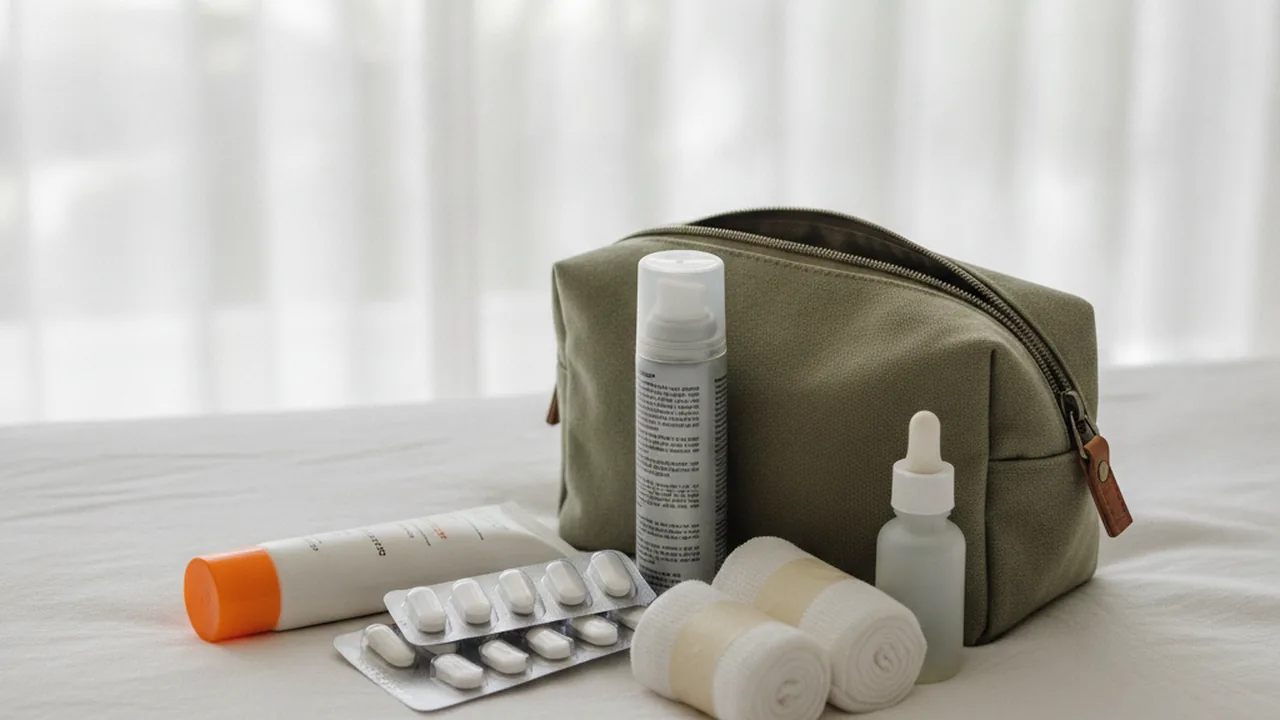
A travel first aid kit for the tropics should always include oral rehydration salts, a sorbent, an antiseptic, a fever reducer and an antihistamine. A trip to Thailand, Vietnam, Bali or Sri Lanka is far more often spoiled by an upset stomach, sunburn or an itchy mosquito bite than by anything exotic. Below is the minimal kit that actually gets used, what you can and cannot bring across the border of each of these four countries, and what to buy at a local pharmacy if your supply did not fit in the suitcase or simply ran out. Still deciding where to go? Have a look at our Thailand overview or try the destination match tool, since pharmacy rules differ noticeably between these countries.
The contents of a travel first aid kit stay much the same wherever you are headed, but customs rules do not: something that clears Vietnamese border control without any paperwork may need a declaration in Indonesia, and a separate permit in Thailand for stronger medicines. Here is the breakdown: what to pack, what is restricted, how to carry personal prescriptions, and what you will find in a local pharmacy.
The essential first aid kit for the tropics
A basic kit covers four situations that come up again and again on a tropical holiday: an upset stomach from new food and water, fever or pain, an allergic reaction or bites, and minor cuts or sunburn. All of these are over-the-counter categories, sold without a prescription both at home and in most pharmacies across the region.
Rehydration and stomach upsets
Oral rehydration salts are the first thing worth packing: heat and unfamiliar food make dehydration almost inevitable with even a mild stomach upset. Add a sorbent (activated charcoal or a newer equivalent) and a broad-spectrum intestinal antiseptic in case of food poisoning. That combination is usually enough to get through a mild episode without seeing a doctor; if symptoms last more than two days or the temperature goes above 38.5°C, that is a reason to get medical care rather than self-treat further.
Fever, pain and inflammation
Paracetamol and ibuprofen cover most everyday situations: fever, headaches, toothache, and inflammation after a knock or bruise. Pack boxes that show the active ingredient in Latin script, since it makes it far easier to explain to a local pharmacist what you need, and that same name is what customs will ask about if any questions come up.
Allergies and bites
A non-drowsy, newer-generation antihistamine helps with reactions to new food, sun or insect bites. It is also worth packing an after-bite gel for mosquitoes and, if you plan to snorkel or dive, a soothing gel for jellyfish stings, which are not uncommon in season around Phuket, Koh Samui and Bali.
Cuts, grazes and sun
An alcohol-free antiseptic (chlorhexidine or similar), a few sizes of adhesive plaster and a panthenol foam or spray are the bare minimum for small cuts and burns. Strictly speaking they are not "medicine," but an insect repellent containing DEET or icaridin and an SPF 50 sunscreen are just as essential in the tropics: both run out faster than expected, and both are easy to buy locally if the original supply was not enough.
What you cannot bring in: the rules by country
The general rule across all four destinations is the same: personal medicine in its original packaging, labelled with its name, travels freely for the length of a trip, and the questions start with prescription, strong or psychotropic drugs. From there, the rules diverge by country.
Thailand: a Thai FDA permit for stronger drugs
In Thailand, medicines for personal use can be brought in for up to 30 days in their original packaging without extra permits, according to Thai FDA. For Schedule II/III drugs (psychotropic or narcotic under Thai classification), a prescription and a separate permit are required, arranged in advance, at least 15 days ahead, via permitfortraveler.fda.moph.go.th; with that permit, a supply of up to 90 days is allowed. General entry requirements are covered in our Thailand visa guide.
Vietnam: prescription and a notarised translation
According to the Russian consular information portal, personal medicines in original packaging travel freely into Vietnam for the duration of a trip. Prescription and strong or psychotropic drugs require a prescription or doctor's letter, ideally with a notarised translation into Vietnamese or English. Narcotic substances without a doctor's order are prohibited.
Bali (Indonesia)
Indonesia's BPOM allows prescription medicines into Bali for up to 90 days with a doctor's prescription. Over-the-counter medicines are capped by quantity: no more than 30 tablets or capsules of one form, and up to 3 packs of any cream, gel, liquid or spray per person. Customs requires an Annex III declaration form, and skipping it for quantities above the personal allowance risks having the medicine confiscated. See our Bali visa guide for entry rules more broadly.
Sri Lanka: up to 90 days without NMRA approval
Under rules from the National Medicines Regulatory Authority (NMRA), a tourist can bring personal-use medicine into Sri Lanka without prior approval, for the length of the trip or up to 90 days, whichever is shorter. Schedule III drugs are not allowed in at all; see our Sri Lanka entry guide for more.
Medicine import requirements by country
| Country | Personal use (no permit needed) | Prescription / strong drugs | Source |
|---|---|---|---|
| Thailand | up to 30 days, original packaging | prescription + Thai FDA permit in advance (≥15 days), up to 90 days | Thai FDA |
| Vietnam | for the length of the trip, original packaging | prescription or doctor's letter, translation recommended | Russian MFA |
| Bali (Indonesia) | quantity limits + Annex III declaration | prescription, up to 90 days | BPOM |
| Sri Lanka | length of trip or up to 90 days, no NMRA approval needed | Schedule III: not permitted | NMRA |
Personal prescription medicines: how to bring them without issues
If you take a prescription medicine regularly, carry a prescription or doctor's letter in English with the drug's international non-proprietary name, which makes both customs checks and buying a local equivalent far easier if a pack gets lost. Keep medicines in their original packaging with the pharmacy label until after landing; move pills into a travel organiser only once past the border, since original packaging with the drug name is what lets officials quickly confirm a personal prescription rather than something else. For strong or psychotropic drugs, check the destination country's requirements well ahead of time: a Thai FDA permit for Thailand, or a declaration and prescription arranged with enough lead time for Bali.
What you can actually buy at a local pharmacy
If a kit did not all fit, or something ran out, pharmacies in the region's major cities and resort areas carry a decent range of over-the-counter medicines.
- Thailand: pharmacies line nearly every tourist street in Phuket, Koh Samui and Bangkok; staff often speak basic English, and many medicines are sold without a prescription that would require one at home (more in our full Thailand guide).
- Vietnam: pharmacy chains are well established in Hanoi, Ho Chi Minh City and Phu Quoc; in smaller towns, English is not guaranteed, so it helps to know the active ingredient's Latin name or have a photo of the packaging (see also our Vietnam guide).
- Bali: tourist areas (Seminyak, Canggu, Ubud) have large pharmacy chains with a familiar range; outside those zones, choice is noticeably narrower (details in our Bali guide).
- Sri Lanka: pharmacies in Colombo and the southern resort towns (Hikkaduwa, Galle, Weligama) sell a basic range of over-the-counter items; for a prescription equivalent, it is best to go through a hotel or a local clinic (see our Sri Lanka guide).
If unsure how to explain a symptom, it is simplest to name the active ingredient itself (paracetamol, loperamide, cetirizine) or show a photo of the packaging from home, so that a pharmacist can find a local equivalent faster, even without knowing the brand name in Russian or English.
Frequently asked questions
Can I bring antibiotics into Thailand?
Antibiotics for personal use on a short trip are usually fine in the original packaging with a prescription or doctor's letter. If it is a controlled drug under Schedule II/III, arrange a Thai FDA permit in advance at permitfortraveler.fda.moph.go.th, allowing at least 15 days.
Do I need an English prescription for Bali?
Yes, for prescription medicines and for customs declaration it helps to carry a prescription or doctor's letter in English. BPOM allows prescription medicines for up to 90 days with a prescription, while over-the-counter items are capped by quantity and require an Annex III declaration.
What if my medicine runs out in Sri Lanka?
Pharmacies in Colombo and the main resort towns stock a reasonable range of over-the-counter medicines: painkillers, antihistamines, antiseptics. A pharmacist may not always have an exact match for a prescription drug from home, so bring enough for chronic conditions.
Can I pack loose pills in hand luggage?
It is better not to move medicines out of their original packaging into a travel organiser until after clearing the border. All four countries expect original packaging with the drug name when checking personal luggage, and loose pills are harder to identify and declare.
Does travel insurance cover medicine in Asia?
It depends on the policy: a basic travel insurance plan usually covers emergency medical care, not everyday over-the-counter items in a first aid kit. See a detailed breakdown in "Travel insurance: what your policy should cover".
Medicine import rules can change. Before travelling, check the official site of the destination country's regulator (Thai FDA, the Russian consular portal, Sri Lanka's NMRA, Indonesia's BPOM).