YuSMP Travel Editorial Team
What's not allowed in Sri Lanka? Some rules feel like local custom or a formality to a first-time visitor, but in practice they carry fines, lengthy court proceedings or deportation. Tourists most often run into trouble over four things: disrespecting Buddha imagery, trying to take plants, shells or animals off the island, drinking in the wrong place, and carrying prohibited goods through customs. We break each one down below, citing official sources where they exist and flagging the ones that aren't backed by a specific published statute. For a wider overview of the island, see our Sri Lanka for Russian travellers guide.
Most of this won't affect a tourist who behaves like a respectful guest in a Buddhist country, leaves plants and animals alone, and follows customs rules. Still, it's worth knowing the specifics in advance — especially around collecting rare plants or shells, where the consequences are far more serious than they look, and around carrying tobacco, which is easy to get wrong without realising it. If you haven't decided where exactly to go on the island, check the Sri Lanka destination page for resorts, seasons and general logistics.
Religion and temples: Buddha statues
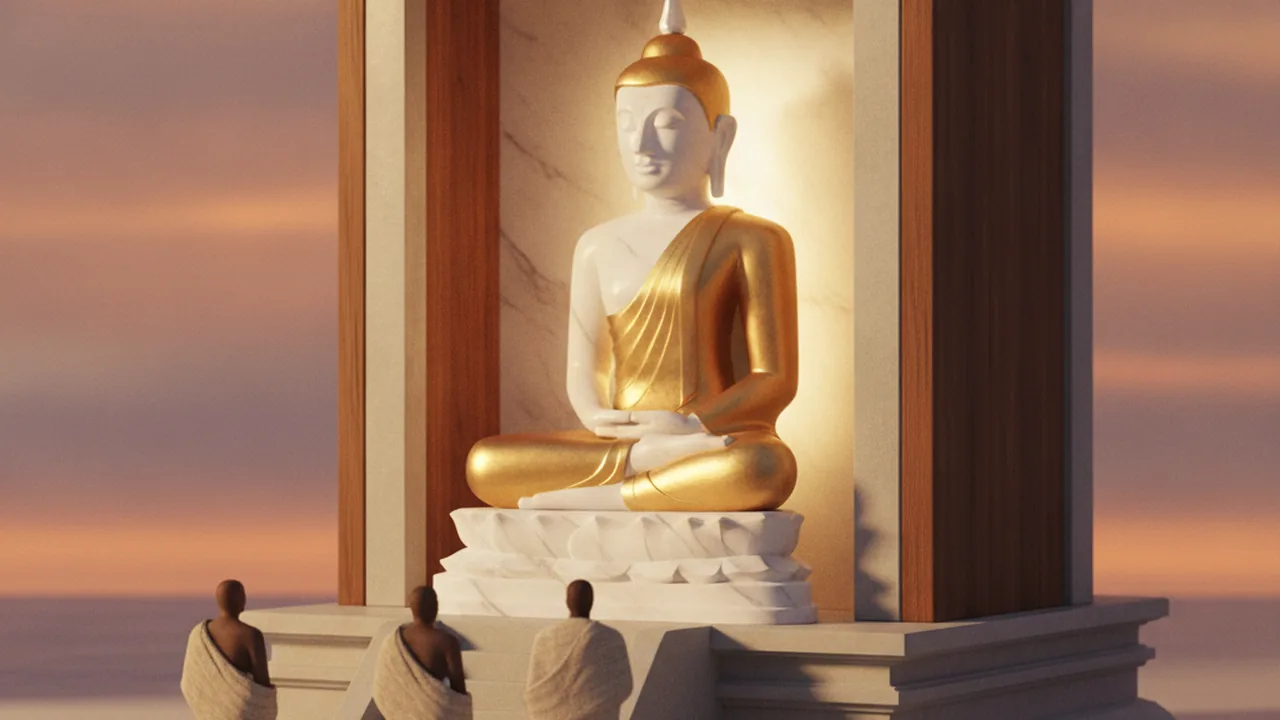
Sri Lanka is a Buddhist country, and how visitors treat images of the Buddha isn't a decorative detail — it's a matter of public sensitivity that the state and police take seriously. A single dress code applies at temples (viharas): shoulders and knees covered, shoes and headwear removed before entering the main hall. Don't sit or stand with your back to a Buddha statue, don't pose right up against one or mimic its posture for a photo, don't point your feet at it, and don't climb onto the altar area without a religious reason.
It's also worth steering clear of clothing, footwear or accessories printed with Buddha imagery — wearing this kind of thing visibly on the island is read as disrespect towards the religion. According to travel guides and official advisories, including Australia's Smartraveller, there are known cases of foreigners being detained or deported over Buddha tattoos or provocative poses next to statues. There's no specific published statute with an exact penalty in open sources, but deportation precedents are well documented, so the sensible approach is not to risk either.
Plants and animals — don't collect or take them home
The rule that catches tourists most off guard has nothing to do with temples: collecting plants, coral, shells, or touching or trying to take animals off the island — from sea turtles to endemic insects — is banned, and the penalty is far steeper than a dress-code fine at a temple. The Russian Embassy in Sri Lanka issued a direct warning to its citizens on this point: according to RIA Novosti (22 June 2026), attempting to collect or remove rare plants and animals can lead to a criminal case, with proceedings lasting a year and a half or more and a final penalty of a fine in the tens of thousands of dollars or a lengthy prison term.
"Tens of thousands of dollars" sounds vague, but that's exactly how the warning describes the range of possible sanctions — the exact figure depends on the species and protected status of whatever was taken. The practical takeaway is simple: a shell from the beach, an exotic plant from a botanical garden, a coral souvenir — none of it is worth the risk of a criminal case that can drag on for years after the tourist has long since gone home.
Alcohol and behaviour in public
Alcohol in Sri Lanka is sold and consumed under a mix of formal and informal restrictions. According to travel guides and official advisories, alcohol sales are suspended nationwide on Buddhist poya days (full-moon days), and some hotels and restaurants apply their own additional limits on those dates — it's worth checking the poya calendar in advance if your trip is tied to specific dates. The same sources put the legal drinking age higher than in most European countries, so staff may ask for ID even if you look older.
Drinking in public — on an open beach, on public transport, or anywhere not licensed for it — is against the rules, as is going topless on busy public beaches outside hotel grounds. In practice, a first offence usually ends with a word from staff or police rather than an on-the-spot fine, but repeated or deliberately provocative behaviour can lead to detention.
Photo and video: what you can't film
Photographing or filming military sites, airports, checkpoints and government buildings in Sri Lanka is prohibited — police or military personnel can detain you for it, especially in areas where security remains tighter after decades of civil conflict. Before pointing a camera at anything that looks government- or military-related, check the surroundings: guards, barriers and warning signs are a clear sign to put the camera away.
A separate rule applies to Buddhist monks: photographing them without permission, let alone touching their robes or asking for a photo together uninvited, is seen as disrespectful. It isn't a criminal offence as such, but locals take it very seriously, and it can quickly draw unwanted attention. The simple rule is to ask first and accept a no without argument.
Customs: what you can't bring in
Sri Lanka Customs enforces a list of goods that either require a declaration or can't be brought in at all. According to the official customs.gov.lk site, tobacco products — cigarettes, cigars, beedis and snuff — aren't covered by the standard duty-free allowance for personal baggage: anything over the limit must be declared and duty paid, and trying to bring it in quietly risks confiscation and a fine.
Planting material with soil attached (plants, seeds, bulbs with earth still on them) is restricted too: customs treats this as a biosecurity risk and requires a phytosanitary certificate, without which the item is seized on the spot. The full list of prohibited and restricted goods sits in Schedule B of Sri Lanka's Customs Ordinance (Chapter 235) and covers narcotics and psychotropic substances, weapons, and antiques or rare books, whose export is separately restricted under cultural-heritage rules. Drugs are their own, most serious category — possession or smuggling leads to a criminal case regardless of the quantity involved. Entry rules and visa requirements are covered in Sri Lanka Visa Rules for Russian Travellers: Entry Requirements in 2026, and general consular information and emergency contacts are on the Russian Consulate General in Sri Lanka site.
Violation — what it leads to
| Violation | What it leads to |
|---|---|
| Photos/poses at a Buddha statue, Buddha tattoos or clothing | Fine, detention, in some cases deportation and an entry ban |
| Collecting or attempting to remove plants, shells, animals | Criminal proceedings from 1.5 years, a fine in the tens of thousands of dollars or imprisonment (Russian Embassy, 22 June 2026) |
| Alcohol or topless behaviour in public, including on the beach | A warning or fine, detention for repeat offences |
| Carrying cigarettes/tobacco without a declaration, planting material with soil | Confiscation, a fine, in some cases a criminal case (Sri Lanka Customs) |
| Photographing military sites, government buildings or monks without permission | Detention, equipment confiscated |
Worth checking before you go: how to pay on the island in How to Pay in Sri Lanka: Cards, QR Codes and Cash, and the best time to visit in Sri Lanka Weather by Month: When to Go. You can also pick dates and a destination through our destination match.
Frequently asked questions
Can I take photos at a Buddha statue?
A photo with the statue in the background is fine as long as you're not posing with your back to it, sitting on its base, or imitating its posture. According to travel advisories and tour guides, exactly this kind of provocative pose or a Buddha tattoo has been the trigger for foreigners being detained and deported.
What happens if I collect plants or shells in Sri Lanka?
According to the Russian Embassy in Sri Lanka (RIA Novosti, 22 June 2026), attempting to collect or remove rare plants and animals can lead to a criminal case: proceedings can run for a year and a half or more, with a final penalty of a fine in the tens of thousands of dollars or imprisonment.
Can I drink alcohol on the beach or in the street?
No, drinking in public places — on an open beach, on transport, in the street — isn't allowed, and alcohol sales are suspended nationwide on Buddhist poya days.
What can't I bring through Sri Lankan customs?
According to Sri Lanka Customs, you can't bring in cigarettes and other tobacco products beyond the allowance without declaring them, planting material with soil without a phytosanitary certificate, or goods on the Schedule B list, which covers narcotics, weapons and antiques subject to export restrictions.
Can I photograph Buddhist monks?
Not without permission: photographing monks, touching their robes, or asking for a photo together uninvited is seen as disrespectful and can draw unwanted attention, although there's no direct fine for it.
Entry rules and fines can change — before your trip, check the latest information on the Russian Consulate General in Sri Lanka site (sri-lanka.mid.ru) and Sri Lanka Customs (customs.gov.lk).