YuSMP Travel Editorial Team
Paying your way around Thailand in 2026 comes down to four options: Thai QR payments through a Russian banking app, a card or wallet from a foreign (non-Russian) bank, cash baht, and — for some vendors — local PromptPay, which Russian apps don't always recognise. Russian bank cards on their own, without a QR wrapper, do not work in Thailand in any scenario. Below is a breakdown of each option, with fees and limits as of October 2026. For the bigger picture on the destination, see our Thailand overview, and for entry rules, our visa guide.
Direct answer: what actually works in Thailand in 2026
The combination that works for a Russian traveller is a Thai QR payment through your own bank's app wherever a business accepts QR (cafes, shops, chain stores), plus cash baht for markets, street food and some taxis. A card or wallet from a foreign bank, if you have one, works almost everywhere like any other foreign card. A Russian bank card is not accepted at terminals or for online bookings — more on that below.
- Thai QR / PromptPay via Sberbank Online, T-Bank or VTB — for payments at registered businesses (Merchant QR);
- a card or wallet from a foreign bank — works contactlessly as usual;
- cash baht — essential for markets, street food, and some taxis and motorbike taxis;
- an ATM — a reliable way to get cash, but with a fixed withdrawal fee.
For the wider picture on paying abroad, not just in Thailand, see “How Russians Can Pay Abroad”. First trip to Thailand? The complete Thailand guide and weather by month are useful starting points, and our destination match tool can help pick your dates.
Do Russian cards work in Thailand?
No, not directly. Visa and Mastercard cards issued by Russian banks are not processed by international payment systems outside Russia — inserting the card into a terminal, tapping it contactlessly, or entering the number on a Thai hotel's website all fail: the transaction simply doesn't clear at any stage of authorisation.
Mir cards aren't accepted in Thailand either — the payment system has no agreements with Thai acquiring banks. So a Russian-issued card isn't a workable tool in any scenario here: not in shops, not at hotels, not for online bookings.
If you hold an account, card or digital wallet with a foreign (non-Russian) bank, most of this stops being an issue — it works in Thailand like any other foreign card, including contactless payments and Apple Pay or Google Pay. If you don't have one, Thai QR through a Russian bank and cash are what's left — covered below.
Paying via Thai QR and PromptPay through Russian banks
Thai QR is Thailand's national QR payment standard, backed by the Bank of Thailand (the regulator), which links it with similar QR schemes in several neighbouring countries. According to Sberbank, Thai QR is accepted at more than 6 million merchant locations — from chain cafes to small shops.
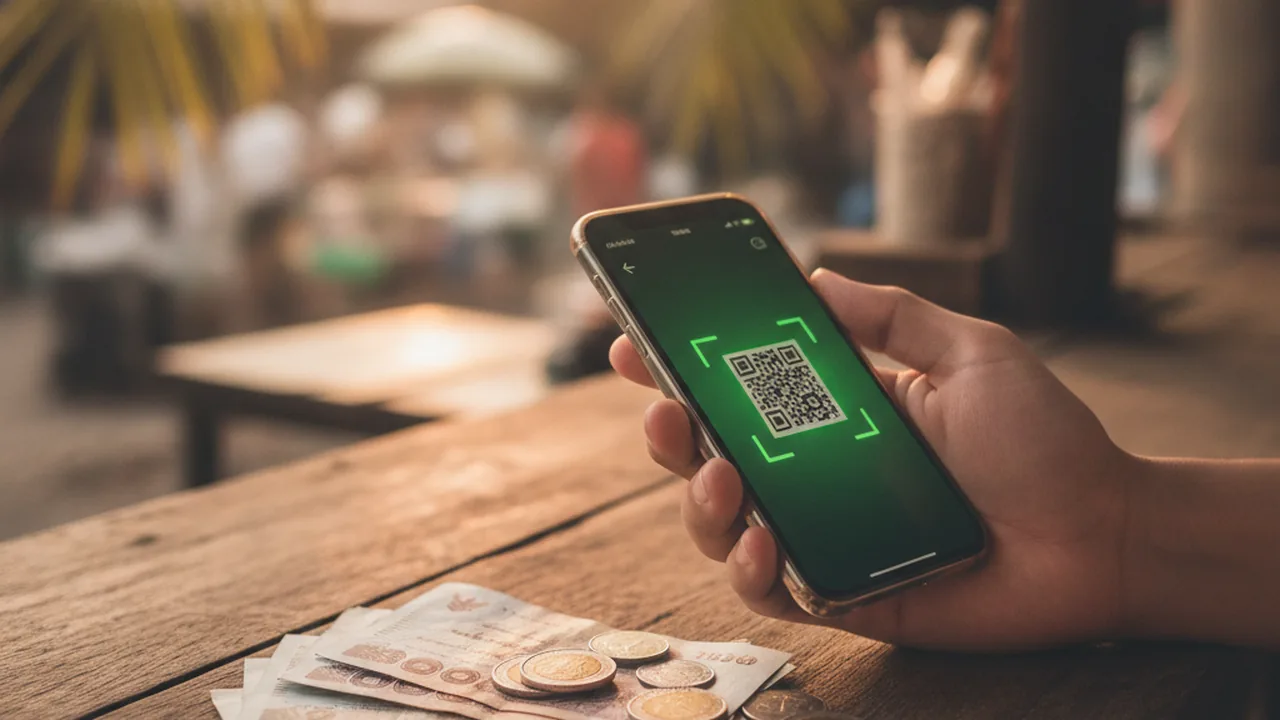
For a traveller, the mechanics are simple: open your bank's app, scan the QR code at the till, the amount converts from baht to roubles at your bank's rate for the day, and the payment clears from your rouble account — no card, no cash withdrawal needed.
How to pay via Sberbank Online
Sberbank added Thai QR payments to its "Sberbank Online" app in April 2026. The flow is straightforward: in the QR payment section you scan the code, the app recognises it as a Thai QR, shows the amount in baht and its rouble equivalent at the bank's rate, and debits roubles from your account once you confirm. No special setup is needed — the feature is available to regular app users.
Which other banks support it, and what to check before you fly
Over the course of 2026, other Russian banks also added Thai QR support — check your own bank's app before you travel to see which countries and QR standards it covers as of your departure date. If your app doesn't have the feature, plan on a foreign card or wallet, or cash, as your main method.
Before you go, it's worth checking your per-transaction and daily limits, confirming that payments abroad are enabled in the app, and carrying a cash buffer for the first day or two in case a QR payment fails to go through technically (see below).
Where Thai QR doesn't work
An important limitation: Russian apps connect to Merchant QR — the code issued by a registered business. Personal QR, shown by an individual seller at a market or a street vendor, usually doesn't go through via Russian banking apps — cash is needed for those cases.
Thai QR also doesn't always help with online bookings or in apps like Grab or Bolt, which typically require a card (a Russian card won't work; you need a foreign one) or a top-up funded another way. The same applies to some hotels, where prepayment is only accepted by international card or bank transfer.
ATMs and cash: what it costs
You'll need cash baht regardless — for markets, street food, some taxis and motorbike taxis, and small shops outside tourist areas. The easiest way to get it is an ATM withdrawal on a foreign bank card: Thailand's ATM network is extensive, and international cards are accepted almost everywhere, including at airports.
Thai banks charge a fixed fee for cash withdrawals on foreign cards — around 220 baht per transaction, regardless of the amount. The rule was introduced by the Thai Bankers' Association back in 2017, and all the major banks follow it — Bangkok Bank, Kasikorn, SCB, Krungsri (as a reference point for October 2026; bank fees change). It's therefore cheaper to withdraw once, in a larger amount that covers several days, rather than making several small withdrawals.
On top of the fixed ATM fee, your card-issuing bank applies its own exchange rate — set on your bank's side, not Thailand's, and it can differ from the market rate.
Table: comparing payment methods
Payment methods in Thailand compared
| Method | Where it works | Fee reference | What to watch for |
|---|---|---|---|
| Thai QR via a Russian bank | Registered businesses with Merchant QR — cafes, shops, chains | Conversion at your bank's rate | Doesn't work with individual sellers or everywhere online |
| Card/wallet from a foreign bank | Almost everywhere, like any foreign card | Set by your own bank | Requires an account outside Russia |
| Cash baht | Markets, street food, taxis, small shops | — | You need to carry it; loss or theft risk |
| ATM withdrawal (foreign card) | Almost all ATMs, including at airports | ~220 baht per transaction + issuer exchange rate | Withdraw less often and in larger amounts — smaller sums mean a higher relative fee |
| Russian bank card | Doesn't work | — | Not processed by international payment systems outside Russia |
What to do if a payment fails
Sberbank attributes most failed payments to a technical cause: the bank doesn't receive confirmation from the payment partner on the Thai side. In that case, the debited amount is returned to your account within seconds — it's a failed attempt, not lost money.
Practical advice: if a QR payment won't go through, don't keep retrying — switch to a backup method (cash, or a foreign card if you have one) and check your balance a bit later: the money has most likely already come back. Keeping a small cash buffer for this isn't overcautious, it's sensible.
Bank rules and fees change faster than articles on the internet get updated: check the current terms in your own bank's app before you travel, and for official details on Thai QR / PromptPay, see the regulator's own page at the Bank of Thailand (bot.or.th).
Frequently asked questions
Can I pay with a Russian card in Thailand?
No. Visa, Mastercard and Mir cards issued by Russian banks aren't processed by Thai banks or international payment systems outside Russia — neither at terminals nor online.
How do I pay by QR through Sberbank Online in Thailand?
In the app, choose QR payment, scan the code at the till, and the app shows the amount in baht and roubles at the bank's rate — confirm, and the money is debited from your rouble account. The feature has worked since April 2026.
How much does an ATM charge for cash withdrawals in Thailand?
Around 220 baht per withdrawal, regardless of the amount — a fixed fee that all major Thai banks have applied since 2017. Plus the exchange rate set by your card-issuing bank.
How much cash should I bring to Thailand?
It depends on your travel style, but keep a buffer for a couple of days ahead — for markets, street food, taxis, and in case a QR payment temporarily fails. Withdraw less often and in larger amounts to avoid paying the ATM fee multiple times.
What should I do if a QR payment fails?
It's usually a technical delay in confirmation from the payment partner — the money comes back within seconds. Switch to a backup payment method and check your balance a little later.
Does Thai QR work in taxis and hotels?
Not always. Personal QR codes from individual drivers and market sellers usually don't go through on Russian apps, and some hotels and services like Grab only accept cards — which means a foreign card, not Thai QR.
Bank rules and fees change — check the current terms in your own bank's app before travelling, and on the official site of the Bank of Thailand (bot.or.th).