YuSMP Travel Editorial Team
Choosing an eSIM for Vietnam comes down to where you're travelling: Viettel is the safer pick for mountain routes and islands, while Vinaphone or MobiFone work fine for cities and the coast. Prices between carriers aren't far apart, but since April 2026 any SIM — including one bought over the counter — comes with an extra facial biometric check. Below are November 2026 prices, the current registration rules, and what sets Vietnam apart from our broader eSIM guide for Asia and our Thailand piece: three carriers with different regional coverage, different prices, and a different regulation. For the wider picture, see the Vietnam overview.
Viettel, Vinaphone, MobiFone: how coverage differs
Vietnam has four network operators, but in practice tourists choose between three. Viettel has the largest infrastructure and the widest coverage of the three: its network reaches mountain regions, the central highlands and islands, where rivals can drop out, and Viettel's 4G officially covers 98.6% of the population. Vinaphone and MobiFone both perform well in cities and on the popular coast — Da Nang, Nha Trang, Ho Chi Minh City, Hanoi — but their coverage noticeably thins out beyond the larger towns. Vietnamobile is the fourth network, with markedly weaker coverage outside major cities; tourists rarely consider it for a travel route.
In practice: if your route includes Sapa, Da Lat, the northern mountains or remote islands, go with Viettel. If you're mostly staying in Da Nang, Nha Trang, Ho Chi Minh City or Hanoi, the coverage difference is minimal, and price and how you buy — eSIM through an app or a physical SIM at a counter — becomes the deciding factor.
eSIM or a physical SIM: what to bring
The right format depends on how long you're travelling and whether you need a Vietnamese number. Vietnam's official tourism portal recommends combining both: a short-term eSIM for the first few days of the trip — so data works as soon as you land, while you figure out where to get a SIM for the rest of the stay — and a local physical SIM for longer stays of more than two to three weeks. It's best to activate the eSIM only after you land, not in advance at home, so you don't burn through a paid plan's days before you even arrive.
You'll want a Vietnamese number if you plan to:
- book rides through local apps that tie to your phone number;
- receive verification codes from Vietnamese banks, delivery or booking services;
- sign up for local messaging apps and services linked to a phone number;
- book hotels or tours by phone directly with Vietnamese providers.
If you don't need a number, a data-only eSIM is enough: it covers maps, messaging apps and social media without a Vietnamese number, and it doesn't always require an in-person check.
How much eSIM/SIM in Vietnam costs in 2026
Tourist plan prices vary quite a bit between the three carriers — from capped daily data to free trials. Here's a price guide in Vietnamese dong and US dollars as of November 2026; the exchange rate used is roughly $1 ≈ 24,000₫, and reseller or retail prices may differ slightly.
Tourist eSIM/SIM prices in Vietnam, guide for November 2026, VND and $
| Carrier | Duration | Data | Price |
|---|---|---|---|
| Viettel | 7 days | 5 GB/day | 60,000₫ (~$2.5) |
| Viettel | 30 days | 5 GB/day | 150,000₫ (~$6) |
| Vinaphone | 15 days | 1 GB/day + 10,000₫ bonus balance | 199,000₫ (~$8) |
| MobiFone (Hi Vietnam) | 24 hours | 8 GB, free trial | 0₫ |
| MobiFone (Hi Vietnam) | 7 days | 50 GB | 120,000₫ (~$4.8) |
The cheapest short-term option is MobiFone's free 24-hour trial through its Hi Vietnam app: 8 GB at no cost, though you'll need to switch to a paid plan afterwards. For a full week of data with almost no limits, MobiFone's 7-day/50 GB plan at 120,000₫ is the better deal. For a full month, Viettel is cheaper: 150,000₫ for 30 days with a 5 GB daily cap.
The new rules: passport and biometrics to buy a SIM
Since July 2024, Vietnam has applied Decree 163/2024/ND-CP (in effect from 24 December 2024): registering any SIM card requires a passport valid for the length of your visa or visa-free stay, and the carrier records the holder's photo. Since 15 April 2026, Thông tư 08/2026/TT-BKHCN added a mandatory four-point verification, including facial biometrics, with in-person registration and the passport in hand at the counter.
SIM registration rules are tightening — for a physical SIM, a passport and photo are mandatory at the counter; for an eSIM bought online in advance, requirements vary by provider, so check at checkout with your chosen carrier or reseller. The official source for eSIM rules and coverage is Vietnam's tourism portal.
For a broader rundown of rules and fines for tourists, see What You Can't Do in Vietnam: Laws and Fines for Tourists, and for general country context see Vietnam for Russian travellers: the complete guide.
Where to buy: airport or city
Carrier counters are present in the international terminals of all major airports.
- Noi Bai (Hanoi): Viettel, Vinaphone and MobiFone counters in the international arrivals area.
- Tan Son Nhat (Ho Chi Minh City): carrier counters right after passport control, near baggage claim.
- Da Nang and Cam Ranh (Nha Trang): smaller counters, but all three carriers are represented — look near the arrivals hall exit.
In the city, SIMs and eSIMs are sold by the retail chains The Gioi Di Dong, FPT Shop and CellphoneS, as well as the carriers' own official stores — these are also where you can extend a plan or switch carriers if one network turns out weaker than expected in your area. If your route spans several regions and seasons, check Vietnam Weather by Month: When to Go to plan where you'll be and when, and which carrier best fits that route.
How to set up an eSIM before you fly
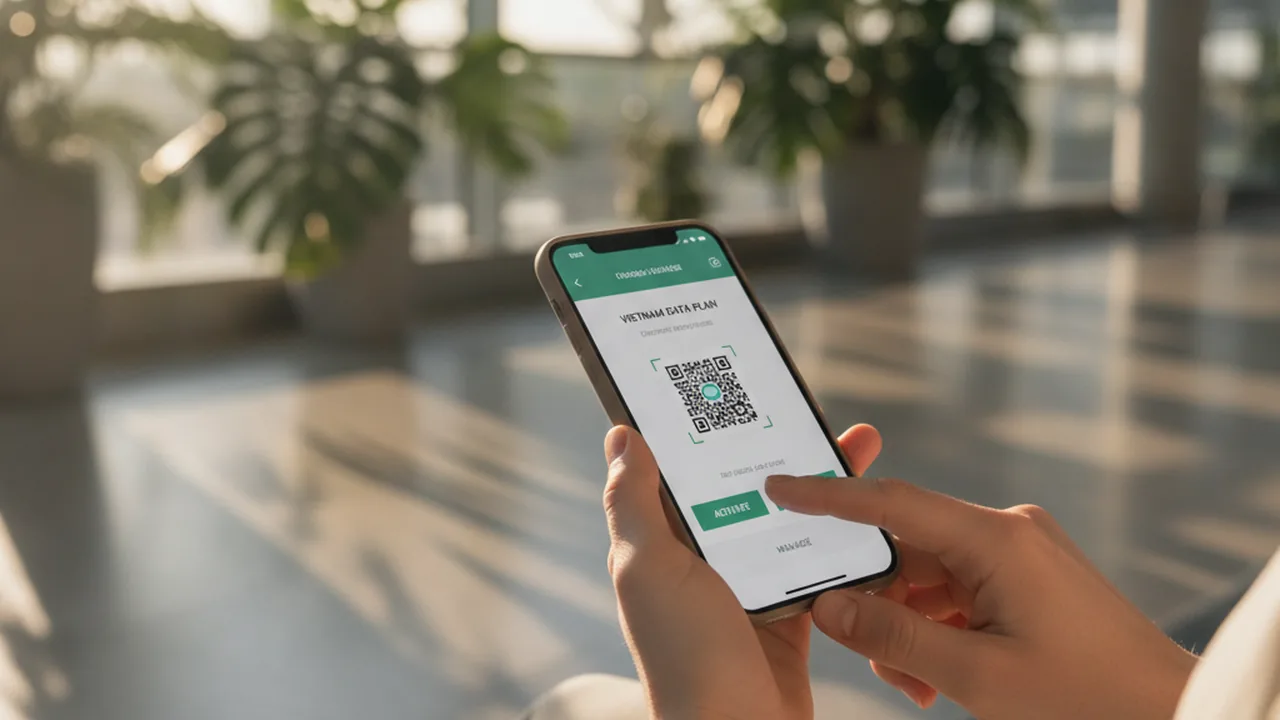
If a data-only plan suits you, you can install the eSIM at home over Wi-Fi: you get a QR code from the carrier or reseller and scan it in your phone's settings — the profile gets added in advance, but you don't need to turn data on yet.
The steps:
- Buy an eSIM from your chosen carrier or reseller and get the QR code.
- Install the profile at home over Wi-Fi via Settings → Cellular → Add eSIM (Android has an equivalent menu option).
- Don't turn on mobile data yet — with some providers, the plan's clock starts running the moment the profile is activated.
- Turn on mobile data only after you land in Vietnam, once your phone picks up your carrier's network.
The only requirement is an eSIM-capable phone (most models from the last 4–5 years support it) and a device unlocked for installing third-party carrier profiles.
Frequently asked questions
Do tourists need a Vietnamese phone number?
No, not if all you need is data: a data-only eSIM covers maps, messaging apps and social media without a Vietnamese number. You'll need a number if you plan to book rides through local apps, receive verification codes from Vietnamese services and banks, or book things by phone.
Which carrier is best for Sapa and the northern mountains?
Viettel — it has the widest coverage in mountainous and remote areas, including the northern highlands and islands. Vinaphone and MobiFone can drop out in those areas.
Can you buy an eSIM in advance and skip a shop visit in Vietnam?
Yes: a data-only eSIM installs over Wi-Fi at home via a QR code from the carrier, and it's best to activate data only after you land. Passport requirements for online purchases vary by provider — check at checkout.
What happens if you don't provide a passport when buying a physical SIM?
The operator will refuse the sale: since 2024, registering a physical SIM in Vietnam has required a passport valid for your length of stay, and since April 2026 it also requires an in-person facial biometric check.
Does a Russian carrier's roaming plan work as an alternative to an eSIM?
Technically yes, but it's almost always more expensive: roaming plans are built for minimal data use, not daily navigation and video, while a local eSIM or SIM gives you gigabytes a day for a few dollars.
What's the difference between MobiFone and Vinaphone for the coast (Da Nang/Nha Trang/Phu Quoc)?
Both networks work well in cities and on popular coastal resorts. The real difference is pricing and how you buy: MobiFone offers a free 24-hour trial through its Hi Vietnam app, while Vinaphone offers longer plans with a bonus balance.
If you're planning the rest of the trip's budget, see how to pay and how much cash to carry in How to Pay in Vietnam: Cards, QR Codes and Cash. For how to get there from Russia, see How to Get to Vietnam from Russia: Direct Flights and Connections. Use our destination match tool to pick dates.
SIM registration rules and prices change — check current conditions on vietnamtourism.com or with an official carrier dealer before you travel.